1. AI Horse Racing Betting 101: What It Is and Why It’s Changing the Game
AI horse racing betting replaces guesswork with numbers you can actually use. At its core, a model produces calibrated probabilities for each runner. Those percentages translate into prices that you can compare with the tote. The conversion is simple. Fair odds equal one divided by the win probability. If your model puts a horse at 22 percent to win, that horse’s fair price is about 4.55 to 1. Right away you have a reference point that takes the mystery out of the board. You are no longer reacting to a sea of changing numbers. You are checking whether the market is paying a price that makes sense.
Expected value turns that reference into a decision. Think of EV as your reality check. For a Win bet, multiply the chance of winning by the net payout, then subtract the chance of losing. If the result is positive, you are being compensated for risk. If it is negative, the pool is priced against you. This habit is what separates a disciplined player from a hopeful one. Artificial intelligence betting predictions help even more when they are part of a simple routine. Use the model to shortlist contenders, convert probabilities into fair odds, and fire only when the tote offers value. That is a repeatable plan for a long season.
There are limits you have to respect. Racing is noisy and takeout reduces every edge. Even a strong approach will go cold in short spurts. Calibration matters more than a ranking. If your 30 percent horses win near 30 percent over time, your numbers behave like prices, not hunches. That is all you need to make better choices. Machine learning horse racing is not magic. It is a way to price uncertainty so you can bet like a professional. It brings structure to decisions, keeps emotions out of the way, and gives you a firm line between action and patience.
2. The Evolution of Machine Learning in Horse Racing Predictions
The story of machine learning horse racing begins with the same elements horseplayers have always cared about. Speed figures still matter. So do pace, class, and trip notes. What changed is how consistently those ingredients get measured and combined. A model does not forget that a barn hits second off a layoff or that a certain post plays short on a wet track. It logs those patterns and updates them with every card. Over time the system sees interactions that are hard to juggle by eye. Maybe inside posts help when the projected pace looks soft, yet the advantage disappears when two speed horses draw in late. A good model captures that nuance.
Different model families shine in different ways. Logistic regression can be great for clean, interpretable probabilities. Gradient boosting and random forests handle nonlinear interactions when variables work together in messy ways. Neural networks can learn deeper structures if the data is plentiful and well prepared. None of these tools promise perfection. Their value shows up when probabilities behave. A 15 percent horse should win like a 15 percent horse over many races. When that happens, you can trust the fair odds you compute.
Training practices improved too. Splitting data into training, validation, and test sets by date keeps the evaluation honest and prevents leaking future information into past predictions. Many shops retrain on a walk-forward schedule so the model stays aligned with the current meet. That matters when maintenance changes how a surface plays or when a local barn heats up and impacts race shape across several weeks. Bettors feel the effect as steadier calibration and fewer wild swings. Artificial intelligence betting predictions are working when they help you price a race the same way every time. That consistency makes it easier to pass bad prices, press good ones, and keep variance in perspective.
3. Data Driven Decisions: How Machine Learning Identifies Winning Opportunities
If AI horse racing betting has a superpower, it is context. A race is not a list of figures. It is a scenario. The projected pace sets the stage. A lone speed threat can carry when the early fractions look soft. A crowded front can drain everyone on or near the lead and hand the race to a stalker. Form cycle markers and trainer intent patterns add more context. A second start after a layoff can be a move-up for certain barns. A switch to the right distance or surface can wake up a runner whose pedigree always hinted at a change. A model weighs these overlapping signals together instead of in isolation.
Once you have a probability, you have a price. Converting a percentage into fair odds takes seconds. Then comes the rule that keeps you honest. Bet only when the tote meets or beats your fair odds by a buffer that covers estimation error and late money. A 10 percent overlay buffer is a practical starting point. This stops you from forcing action in marginal spots. In pari-mutuel pools, selectivity is a weapon. Takeout penalizes every guess, so the fewer low quality decisions you make, the better your season looks. Requiring minimum pool sizes is another guardrail. In small pools, a single bet can crush your own price and erase the very edge you thought you found.
After every race, a quick post-mortem keeps the process sharp. Did scratches change the pace picture that drove your play. Did weather move the race off the turf and shift how the track played. Were you betting a trainer pattern that has cooled recently. You do not need pages of notes. You need a habit of checking whether the thesis held. Over time this habit refines your thresholds, highlights which features actually carry signal, and cuts out dead angles. Machine learning horse racing is at its best when it helps you predict not only who is live, but why, and at what price the idea is worth your money.
4. Inside the Black Box: Artificial Intelligence Betting Predictions Explained
The phrase “black box” makes AI sound mysterious. In practice, quality artificial intelligence betting predictions are built on straightforward rules of good data. Only use information that was available before the race. Do not leak future details like final odds, chart comments that rely on knowing the outcome, or derived metrics that incorporate the result. Leakage makes backtests look great and real bets look bad. Responsible pipelines also account for the realities bettors see in real time. Scratches, off-the-turf switches, distance changes, and equipment notes should be reflected in the inputs if they were known near post.
Calibration is the first thing to check before you trust any probability. A simple reliability plot groups horses by predicted win rate and compares that to how often they actually win. If the 30 percent bucket wins near 30 percent across a large sample, the model is behaving. Numerical metrics like Brier score and log loss capture the same idea by punishing high-confidence mistakes more than small ones. Stability across segments is next. Dirt and turf, sprints and routes, small and large fields, and various class levels should all show reasonable results. If a model collapses once the field size changes or the surface switches, you are dealing with an overfit tool.
Ensembles are a sensible way to balance strengths. Blending a calibrated logistic regression with a gradient boosting model that captures nonlinearities can produce smoother probabilities than either alone. Presentation matters too. Bettors need more than a single “pick.” They need a ranked set with probabilities and a sense of the confidence spread so tickets can be sized rationally. A short summary of what drives the estimate helps. If a horse earns its chance because the projected pace favors its style, a bettor can evaluate scratches and track bias quickly. Machine learning horse racing is useful when it gives you numbers that act like prices and explanations that line up with how races unfold.
5. Markets, Odds, and Models: Using AI to Spot Value Before the Tote Board Moves
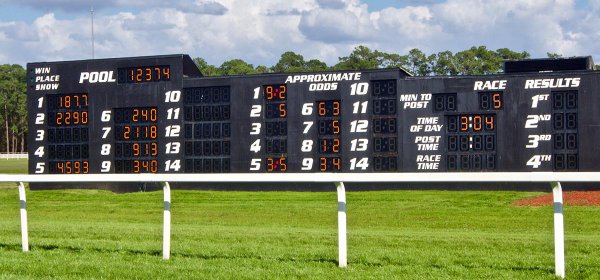
A model helps you set a fair price. The tote tells you what the market is willing to pay. The edge lives in that gap. In live play, that means watching the board and asking a simple question. Does the price on offer meet my threshold. If your fair odds are 4.5 to 1 and the tote sits at 6 to 1, the answer can be yes if your overlay buffer is satisfied. If the board pays less than your fair price, you pass. That one habit will protect more bankroll than any clever angle. It turns speculation into a series of rational accept or decline decisions.
Liquidity decides how easy it is to capture the edge you see. In big pools near post time, your stake rarely moves the price. In small pools, a $200 Win bet can push a horse down fast and erase your advantage. That is why minimum pool thresholds matter. It is also why many players scale their stake based on pool size. Late money is a fact of life. Popular contenders often shorten right before the bell. You can defend your EV by using conditional or queued orders that only send when the screen shows a qualifying price. If the price evaporates, your order never hits. Passing a race is a skill, not a failure.
Exotic pools can stay inefficient longer than the Win pool because there are so many combinations to price. If your model narrows contenders and assigns realistic relative chances, you can build Exacta or Trifecta structures that reflect joint probabilities rather than guesswork. Pressing a strong top opinion while spreading intelligently underneath is a sound way to turn a fair single into a positive EV ticket. Guardrails make the whole plan more robust. Odds floors and ceilings, cancel rules tied to scratches or surface switches, and a hard cap on total exposure per race keep execution calm when the board starts jumping.
6. I Used AI to Bet on Horse Racing: Real Results and Lessons Learned
A real test of AI horse racing betting starts with a written plan. Pick a set window, choose your tracks, and define the pools you will play. Write down how you convert probabilities into fair odds and the minimum overlay percentage that triggers a bet. Commit to sizing before you place the first ticket. Fixed fraction staking or fractional Kelly fit the variance of this game far better than full Kelly. Racing delivers streaks. A conservative risk per race keeps you alive to see your edge play out across many wagers.
Measurement turns stories into facts. Track ROI, but also record drawdowns and the number of bets so you know how much noise sits in your results. Compare your taken price to the final price. In pari-mutuel pools the final flash is not always a perfect measure, but over time you will see whether you consistently beat the close. That is a sign you are identifying value before the crowd. After each card, run a short post-race audit. Did late scratches change the pace picture that justified a play. Did weather shift the surface and undermine a key assumption. Would your rules have made the same bet if you had perfect hindsight on those changes. Keep the review short and focused. You are tuning a system, not replaying bad beats.
Have a pause and reset protocol. If your edge fades across a meaningful sample, stop live betting and switch to paper trades while you recalibrate or retrain. Racing regimes do change. Barns heat up then cool off. Maintenance can change how a surface plays for a week. A calendar shift can alter field quality. Recognizing that drift early protects your bankroll. The biggest lesson is simple. Artificial intelligence betting predictions deliver value only when paired with consistent pricing, sensible sizing, and the willingness to pass. You are not trying to win every race. You are trying to make a series of positive EV decisions that add up over the meet.
7. Free Artificial Intelligence Betting Predictions: Where to Find Them and How to Vet Them
Free artificial intelligence betting predictions are everywhere, and many of them look tempting when they post a hot day. Treat them like tips that need verification. The first filter is evidence. A credible source publishes long-run hit rates and returns that are segmented by track, surface, and distance. A single blended number can hide where a method actually works. The next filter is transparency. You want a stated data window, an update cadence that matches live racing, and sample sizes large enough to matter. Without those basics, you are reacting to marketing, not a model.
Calibration is the quickest truth test you can run at home. If a feed says its top selections win 40 percent of the time, log a few months and check whether that bucket lands near 40 percent. Large gaps tell you the probabilities are not behaving. In practice, the healthiest way to use a free feed is as a screen. Let it point you toward races that might be live, then run those races through your own fair odds and overlay rules. When your numbers agree and the tote pays a qualifying price, you have a stronger case. When they diverge, you save money by doing nothing.
There are obvious red flags. Cherry-picked screenshots, tiny samples that trumpet a single week, and promises of guaranteed profits do not match the reality of pari-mutuel markets with takeout and sharp competition. A feed that shows both winners and losers, explains its approach at a high level, and acknowledges variance is more likely to help a serious player. Free tools can still save time or surface contenders you might have missed. The key is to keep control of the final call. Treat every outside signal as an input to your own AI horse racing betting workflow rather than as a command to bet.
8. Comparing the Best Artificial Intelligence Betting Predictions Platforms
When you evaluate the best artificial intelligence betting predictions platforms, start with coverage and freshness. Confirm which tracks and circuits are included and how many seasons of history sit behind the numbers. Ask how quickly scratches, equipment notes, and surface switches flow into the system. Fresh inputs reduce operational mistakes that can turn a good idea into a bad ticket. Most reputable platforms publish performance pages. The useful ones break results down by track, surface, distance, class, and field size. That segmentation lets you focus on the spots where a platform’s edge has actually shown up.
Tooling decides whether good numbers become good decisions before the bell. A clear display that shows model probabilities next to calculated fair odds and live odds lets you compare value at a glance. An expected value calculator that incorporates takeout keeps choices grounded in reality. Filters by track, race type, overlay size, and confidence help you act quickly as post time approaches. Integrations that support conditional orders are valuable if they respect your rules and fire only at qualifying prices. Performance under load matters because many players will hammer the interface at the same time. If the site slows when the board starts moving, prices will slip away.
Price the subscription against your realistic volume and edge. Estimate how many bets you will place, your typical stake, and a conservative average EV per bet. A platform earns its fee when that math comes out ahead over time. Extras like clean exports, short documentation of feature categories, retrain schedules, and plain-English validation methods build trust without exposing proprietary code. Machine learning horse racing tools are useful when they act like probability engines and fit into a fast, repeatable workflow. Choose the platform that matches your style, publishes segmented evidence, and stays stable during the busiest moments of the card.
9. Becoming a Savvy Horseplayer: How to Use AI for Smarter Bets
Turning AI into results starts with a written rulebook that turns numbers into actions. Set a minimum overlay percentage that must be present before any Win bet is placed. List the tracks you will avoid because of chronic low liquidity or unpredictable biases. Define minimum pool sizes for Win and Exacta wagers so your stake does not move the price against you. Decide how scratches will be handled, including when a bet is canceled because a key pace horse came out. When those rules are in place, pressure fades. You are not ad-libbing five minutes before the bell. You are following a plan.
Ticket construction improves when probabilities guide structure instead of gut feel. Press strong opinions when a contender’s price sits clearly above fair odds. Spread where the model indicates wider uncertainty. In multi-race wagers, direct more coverage to volatile legs where pace scenarios can flip and keep things lean when a standout sits at a playable price. Bankroll management must respect racing’s variance. Fixed fraction staking, daily loss caps, and cool-off periods after large drawdowns keep you in the game when results cluster. Those controls turn a solid edge into a sustainable season rather than a streak that ends in frustration.
Diversify within your strengths. If your model consistently finds value in Exactas or Trifectas, it is sensible to shift more volume there instead of forcing Win bets that fail your threshold. Keep a simple log that records model probability, fair odds, taken price, and the final price, along with quick notes on pace and bias. Review results weekly. Retire angles that slip. Scale angles that hold. This review does not need to be elaborate. It needs to be honest. AI horse racing betting works best when human judgment keeps the system calibrated, the rules stay consistent, and the bankroll stays sized small enough to survive the cold spells that come for everyone.
10. Risks and Rewards: What AI Horse Racing Betting Means for the Future
As more bettors use artificial intelligence, markets will likely get a bit sharper. That does not erase opportunity. It shifts the focus. Expect fewer giant overlays and more chances to capture small edges with precise execution. That environment rewards calibration, clear thresholds, and the patience to pass when the price is wrong. Regime shifts will always shape results. Barn form runs hot and then cools. Track maintenance and weather change how a surface plays. Calendar swings alter field quality. The smart response is a schedule of validation and retraining so your model reflects the present rather than a story from six months ago.
Operational risk matters just as much as a good number. Data delays can feed stale inputs into decisions. Tote hiccups can cause a bet to miss a qualifying price. Late scratches can break the pace picture that justified a ticket. You can protect yourself with backup tracks, alternative pools, and cancel rules tied to specific changes in conditions. Human insight still has a place next to the model. Trip notes that reveal a troubled break with strong late energy, paddock observations that confirm or question fitness, and trainer tells that hint at intent can all add signal. Combine those observations with probability-based pricing and you get an edge that survives a changing market.
Set expectations like a professional. Positive EV strategies still produce losing runs, especially at longer prices where payouts arrive less often. Keeping stakes small enough to survive the dry spells is a competitive advantage. AI horse racing betting will keep evolving, but the bedrock remains the same. Calibrated probabilities become fair odds. Fair odds compared to the tote reveal value. Disciplined bankroll rules turn value into steady returns over time. The bettors who thrive are the ones who use machine learning horse racing tools to price uncertainty, stick to clear rules, and stay humble enough to pass when the market refuses to pay.