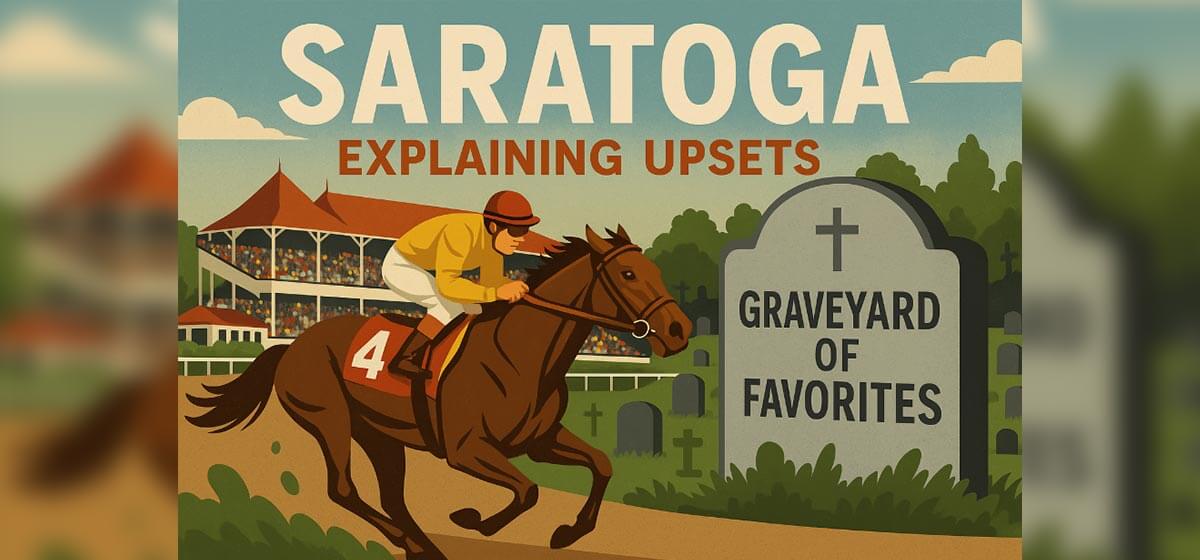
Saratoga is the track where “sure things” get humbled. A favorite can walk into the paddock gleaming like polished bronze, only to come back looking very mortal when the real running starts. The phrase “Saratoga graveyard of favorites” did not come from marketing. It grew out of real shocks, from Man o’ War’s only defeat to American Pharoah getting nailed in the Travers, and from the daily grind of deep fields at this racetrack in upstate New York.
If you want to bet the summer meet at Saratoga with confidence, you need more than tradition and vibes. You need to understand Saratoga Race Course history, the way the Saratoga dirt track and Saratoga turf course are laid out, how Saratoga track bias shifts with weather and maintenance, and where the biggest Saratoga surprises have come from. This long-form guide keeps the storytelling, but it also leans on information documented by NYRA, Equibase, and major racing outlets so you can trust what you are reading. The goal is simple: help you enjoy the Spa race course and give you a better chance to keep your tickets out of the graveyard.
1. How Saratoga Earned the Title “Graveyard of Favorites”
Saratoga Race Course opened in 1863 and is widely considered the oldest major sporting venue in the United States, which means it has had a very long time to break hearts and favorites. Over that span, the track gained a reputation for beating big names often enough that fans and writers began calling it the “Graveyard of Favorites” or the “Graveyard of Champions,” a label still used in mainstream coverage whenever a high-profile horse goes down.
The quality of competition at the summer meet Saratoga is a major reason the nickname has stuck. NYRA’s stakes schedules make it clear that the Spa meet is built around high-end races like the Travers, Whitney, and Alabama, and that the meet draws top barns from across the country for a 40-day stand between July and early September. When that many strong outfits converge, even short-priced horses are facing rivals with real ability. A favorite who would tower over a field at a softer meet often finds itself only marginally better than the second, third, or fourth choices at Saratoga.
Juvenile racing adds even more volatility. Saratoga’s card traditionally includes key 2-year-old races such as the Sanford, the Hopeful, and many maiden events, which have long served as launching pads for future stars. These races are built around lightly raced or debuting horses whose true level is not yet fully known. The public tends to pile onto fashionable barns and high-priced sales graduates, but those horses can be short on experience or fitness. Meanwhile, a less-hyped runner with a strong local work pattern can be fully cranked and ready to spring a surprise.
Weather and footing complete the picture. Track information and local guides note that the main course at Saratoga is a 1 1/8-mile dirt track with a one-mile turf course inside it, all exposed to upstate New York’s summer storms. A day that starts on a fast dirt track and firm turf can quickly shift to sloppy dirt and yielding turf. Horses with great past figures on one type of going can suddenly find themselves on something totally different. When crowds bet favorites strictly off old speed figures without adjusting for those changes, they feed the graveyard.
2. The Upsets That Defined the Spa: From Man o’ War to Modern Day Shockers
The “Saratoga graveyard of favorites” label is backed by specific, well-documented upsets. Man o’ War, one of the greatest Thoroughbreds in history, lost the Sanford Stakes at Saratoga in 1919 to a colt named Upset, the only defeat in his 21-race career. Contemporary reports and later analysis agree that a bad start, traffic, and weight helped turn that race into a rare stumble for Big Red, and the fact that it happened at Saratoga is part of why the legend lingers.
Travers Stakes history adds another pillar. In 1930, Triple Crown winner Gallant Fox went off as a heavy favorite in the Travers, only to be beaten by Jim Dandy in a sea of mud. Historical pieces describe Jim Dandy’s estimated 100-1 odds, the deep, sticky track that day, and his rail-hugging trip as key factors in the upset. The result was so famous that a major Saratoga prep race, the Jim Dandy Stakes, now carries his name.
Modern fans know the Keen Ice over American Pharoah Travers all too well. On Travers Day 2015, American Pharoah arrived as the first Triple Crown winner in 37 years, yet Keen Ice caught him late to win the Mid-Summer Derby. National sports coverage treated the result as a classic Saratoga shock, highlighting how a strong pace, a demanding season, and the 1 1/4-mile distance opened the door.
These races are not just folklore. They are documented examples of stars being undone by specific combinations of pace, surface, and circumstances at Saratoga. Man o’ War’s start, Gallant Fox’s dislike of the deep mud, American Pharoah’s demanding season and pace pressure: in each case, the favorite lost in a way that makes sense when you study the conditions. That is the key lesson for bettors. Saratoga upsets usually have logical roots. Your job is to spot the same ingredients before, not after, the race.
3. Inside Saratoga Race Course: A Brief History Of America’s Oldest Major Track
Saratoga Race Course sits on Union Avenue in Saratoga Springs, New York, and opened on its current site in 1864 after an initial meeting on a nearby track the year before. It is regularly described as one of the oldest racetracks and sporting venues in the United States, and its long continuity is part of its appeal. Fans standing along the rail today are watching races on the same ground where 19th-century horseplayers sweated results in straw hats.
The physical layout of the Spa race course is distinctive and well documented. The main Saratoga dirt track is a 1 1/8-mile oval with sweeping turns and chutes for different distances. Inside the dirt sits the Mellon Turf Course, a one-mile grass oval. Inside that is the inner turf, which measures seven furlongs and features noticeably tighter turns. This three-layer layout separates Saratoga from many other tracks that run everything on a simple one-mile configuration. At Saratoga, each surface has its own personality and demands.
Across Union Avenue sits the Oklahoma Training Track, another piece of Saratoga Race Course history that matters more than casual fans realize. Horses stabled at the meet log many of their morning miles over that separate oval. For handicappers, workout lines that mention Oklahoma tell you a horse has been in town and getting comfortable over local surfaces. That can be a real edge compared with a runner who arrives from another circuit and has not had that same chance to adjust.
The racing program itself reflects the track’s age and status. Travers Stakes history begins in 1864, giving Saratoga a stakes race older than the Kentucky Derby. The Whitney, Alabama, Hopeful, and other historic events fill out a program that feels more like a festival of stakes and high-quality allowances than a simple meet. That is why people talk about the summer meet Saratoga as its own season, separate from the rest of the New York calendar. Every division, from 2-year-olds to top older horses, gets a chance to shine at the Spa.
Around all of this is the town itself. Saratoga Springs is known for its mineral water, historic hotels, and streets that fill with racing fans, horsemen, and tourists every summer. When you walk into Saratoga Race Course, you are walking into a place where vacation culture and serious betting culture mix. That blend creates a charged, slightly unpredictable atmosphere that fits perfectly with the reputation of a track that refuses to let favorites coast.
4. Understanding Saratoga’s Dirt Track: Configuration, Pace Pressure, And Bias Patterns
Handicappers often start with the main track, and Saratoga’s dirt surface deserves that attention. The Saratoga dirt track is a left-handed oval measuring 1 1/8 miles. That extra distance beyond a standard one-mile track changes how races are run. The start of many routes comes relatively close to the first turn. Jockeys know this, so they ask their horses for position early. Horses with natural tactical speed benefit, because they can claim a spot near the lead and save ground before the field strings out.
This configuration explains why so many Saratoga handicapping tips emphasize tactical speed over deep closing ability. A horse that likes to sit midpack or just behind the leaders, then punch on, often gets the best of both worlds. That horse stays close enough to use a favorable Saratoga track bias if the inside is strong, yet is far enough off the early battle to finish when the leaders get tired. True closers can still win, but they need help from pace collapses or a surface that is giving them an extra push.
Bias is the word that gets talked about in the backyard all day long. Some days, the rail is golden on the Saratoga dirt track. Horses that secure the inside path seem to carry their speed farther than their past form would suggest. On other days, the rail dulls out and winners come from two, three, or even four paths off the fence. Weather and maintenance are usually the reasons. A sealed track after a storm can become a runway for speed. A drying surface can develop sweet spots that change as the day goes along.
Shorter dirt races have their own feel. Six and seven furlong sprints at Saratoga often reward horses that break sharply and either clear the field or sit just off the pace in the right lane. Outside posts can be an advantage on some days when the inside is not as strong. Routes at 1 1/8 miles show how much a horse likes two turns. Runners who have made a living in one-turn 1-mile or 1 1/16-mile races at Belmont sometimes find that the extra turn and different rhythm at Saratoga expose stamina or trip issues.
The only way to stay ahead of Saratoga track bias on the dirt is to watch the card develop. Pay attention to how the first few races are won. Notice whether the winners are hugging the rail or winning from the three path. See if closers are making up ground or flattening out. Watch whether early speed horses are hanging on despite pressure. These clues tell you how the surface is playing in real time. At a track with a reputation as the Graveyard of Favorites, that information is too valuable to ignore.
5. Saratoga’s Turf Course Nuances: Tight Turns, Traffic Trouble, And Trip Dependent Racing
If the dirt track is where most of the headlines come from, the Saratoga turf course is where a lot of bankrolls are built or broken quietly. The Mellon Turf Course on the outside is one mile around. The inner turf nestled inside it is seven furlongs and noticeably tighter. That difference in shape is important. Horses that handle wide, sweeping turns elsewhere sometimes struggle when the turns come up more quickly on the inner course.
Saving ground is the name of the game in Saratoga turf racing. A horse that spends both turns on or near the rail is simply traveling less distance than one parked three wide throughout. Over 1 1/16 miles or 1 1/8 miles, that extra ground adds up. In replay after replay, you can see longshots who never left the inside until they tipped out in the stretch running over the top of favored horses that did the hard work wide.
Large fields are another trademark of Saratoga turf races. It is not unusual to see 10 or more horses in a grass allowance or claiming race. With that many runners, traffic trouble becomes part of the handicapping puzzle. A strong closer can be rendered useless if stuck behind a fading rival with nowhere to go. A horse with moderate ability can win at a price simply by getting a clean run at the right time. That is why trip notes and replay work matter so much for the Saratoga turf course.
Weather and temporary rails change things again. A fast-moving summer storm can turn a firm turf course into a yielding one in a single afternoon. Some horses relish a bit of cut in the ground. Others lose their action and never pick up. Rails pushed far out create tighter turns and reduce the amount of room for wide runs. Rails moved back in expose fresher ground on the inside and can tilt things back toward closers who are willing to wait and slice through.
When you combine these factors, Saratoga turf races become some of the most trip dependent events in American racing. For bettors, that is not a reason to shy away. It is an invitation to gain an edge. Watching replays, tracking rail positions, and learning which barns aim specific horses at the turf during the summer meet Saratoga can turn those seemingly chaotic fields into profitable setups. The crowd sees a wall of numbers. You see which horse had the worst trip last time and now lands the right post, the right rail setting, and the right jockey.
6. Why Favorites Falter: The Betting Environment And Depth Of Competition At The Summer Meet
If you zoom out and look at the summer meet Saratoga as a whole, it becomes easier to see why favorites have such a hard time living up to their status. The level of competition is relentless. Trainers do not send their B strings to Saratoga. They bring horses they think can handle the Spa race course, handle the travel, and handle pressure. That means even in an ordinary allowance race, you might see shippers from major circuits, local stakes performers dropping slightly in class, and lightly raced runners on the rise.
Maiden and 2-year-old races are especially dangerous for favorites. These events are full of unknowns. A barn known for juvenile success might send out two debut runners in the same race. One will take most of the money based on rumor and workout buzz, while the other quietly outruns expectations. Another stable might bring in a second-time starter who had a nightmare trip first out and is now ready to improve, yet the crowd is still focused on the pricier, more hyped rival.
Public betting behavior adds fuel. Many players lean on recognizable trainers and riders because it feels safer. That instinct is understandable, but it does not always match reality. On a card where several trainers all have strong chances, the crowd can herd around one familiar name and compress the odds on that horse. The result is a favorite who is shorter than it should be and several rivals whose prices drift higher than their real chances justify.
Saratoga is also a testing ground. Trainers use the meet to learn more about their horses. A colt might try turf for the first time. A filly might stretch from sprints to routes. Some of these experiments hit immediately and create Saratoga surprises. Others are stepping stones that connections are not truly trying to win with. If the crowd treats every new surface or distance move from a big barn as a sure thing, they will back a lot of horses that are not being cranked to run their very best that day.
The riding style at Saratoga plays a part too. With so many eyes on this meet, jockeys push for position and are less willing to concede ideal trips. That can create hot paces, tight quarters, and chain-reaction trouble that hurts short-priced horses as much as longshots. When you mix all of this together, Saratoga becomes the perfect environment for favorite win percentages to sag and for price horses to jump up at just the right time.
7. Travers Stakes History: How The Mid Summer Derby Became A Stage For Surprises
Travers Stakes history sits right at the heart of Saratoga’s identity. First run in 1864, the Travers is older than the Kentucky Derby and has long been known as the Mid-Summer Derby. It offers 3-year-olds a chance to prove themselves again after the spring classics, on a different course, at a different time of year, over 1 1/4 miles on the Saratoga dirt track.
The Travers has seen plenty of stars, but it has also delivered some of the most memorable Saratoga upsets. The already mentioned Jim Dandy over Gallant Fox in 1930 is perhaps the most famous early example. It turned a Triple Crown hero into a beaten favorite and a mud-loving outsider into a legend with his own stakes race. More recently, Keen Ice’s late run past American Pharoah in the 2015 Travers showed that even a modern Triple Crown winner can be vulnerable when pace, distance, and form all meet in a way that favors a rival.
The race is naturally volatile because of the way 3-year-olds develop. The colt who was the best in May is not always the best in August. Some need time to grow into their frame. Others peak early and regress. Some point specifically to the Travers as a long-term target, skipping earlier dances in order to arrive fresh. If you only handicap the Travers by looking at Kentucky Derby or Belmont form, you miss the fact that the division often shifts under the surface as the season goes on.
Distance is another key factor. The 1 1/4 miles of the Travers is a test of stamina as well as talent. Horses who ran well at nine furlongs might not finish the same way when they go an extra furlong at Saratoga, especially if the pace is honest or the track is not playing perfectly to speed. That opens the door for grinders and late runners who may not have had the right setups earlier in the year.
For handicappers, the Travers is a race where Saratoga handicapping tips come into full focus. You want to know how the Saratoga dirt track has been playing in the weeks leading up to the Mid-Summer Derby. You want to know which horses have handled the Spa in prep races and which ones are trying it for the first time. You want to consider whether the likely favorite is truly on an upward form cycle or is flattening out after a demanding spring. When you ask those questions, you put yourself in position to spot the next horse that turns Travers Stakes history in its favor.
8. The Traditions That Shape The Spa: Bell Ringing, Backstretch Culture, And Race Day Atmosphere
Part of what makes Saratoga so different from other tracks is what happens when the horses are not running. Saratoga traditions shape the rhythm of the day and deepen the connection between bettors, horsemen, and the place itself. The bell ringing tradition at Saratoga is one of the simplest and most powerful examples. Seventeen minutes before each race, a bell in the winner’s circle is rung five times. That sound has been the cue for horses and horsemen to head to the paddock since long before digital timers and massive video boards existed. Even now, it gives each race a little ceremony and a sense that something important is about to happen.
Mornings at the Spa race course feel almost like a different world. The grandstand is open, the main track is busy with training, and the Oklahoma Training Track across the street hums with activity. Fans can eat breakfast while watching horses breeze, listening to hooves hitting the ground and trainers talking through plans along the rail. For serious players, these mornings are not just entertainment. Watching how a horse moves, how sharply it finishes a work, or how relaxed it looks on the way back can turn into a clue that matters later, especially when that horse appears on a Saratoga card a week or two down the line.
The backyard is the social heart of Saratoga Race Course. Fans arrive early to claim picnic tables under the trees, spread out their programs, and turn the shaded lawn into a kind of open-air handicapping parlor. Some will wander up to the Saratoga Race Course Turf Terrace for a better view. Others stay closer to the paddock so they can get one more look at the horses before placing a wager. Conversations drift naturally from Saratoga track bias to which trainer is heating up to which longshot in the next race might be sitting on a move forward.
Behind the scenes, there is a long-standing backstretch culture that the public only glimpses. Many grooms, hotwalkers, exercise riders, and other workers return year after year. They know which barns tend to peak early in the meet and which ones hit stride later. They know which horses thrive in the close, high-energy Saratoga environment and which ones get rattled by the noise and the attention. Trainers and jockeys are shaped by that culture too. It is hard to walk into a paddock surrounded by Travers canoes, historic photos, and full grandstands without feeling the weight of Saratoga Race Course history.
All of these traditions matter to bettors because they influence how people and horses respond to the environment. A nervous horse can react to the noise around the paddock and backyard. A veteran who has been through multiple Saratoga seasons might relax into the routine. When you factor those surroundings into what you see in the paddock and post parade, you are grounding your read in how the Spa actually operates, not in speculation.
9. Saratoga Handicapping Tips: Practical Ways To Identify Live Longshots And Vulnerable Chalk
When you build Saratoga handicapping tips, the first step is to anchor them in what is formally known about the track, not just personal hunches. You know from official materials that the main course is 1 1/8 miles and the turf course is 1 mile, and that a separate inner turf exists with its own dimensions and rail settings. You know from recorded track records what fast times look like at those distances. From those facts, you can logically say that tactical speed tends to matter on dirt and ground-saving trips matter on turf.
You also know, from morning workout programs and training tours, that many horses prepare over the Oklahoma Training Track and the main course before appearing in afternoon entries. When you see steady local works in the past performances, that is not a guess about a horse “loving Saratoga.” It is an observable pattern backed by the way the facility is actually set up. Horses that have been in town and working regularly over the local track often show up ready to fire.
The importance of trip handicapping on the Saratoga turf course is reinforced by how often major races and media recaps mention traffic problems and wide journeys in describing losers and winners. With large fields and tight inner turns, it is factual to say that some horses will get blocked and never truly run. Watching replays and noting which horses were stopped cold, shuffled back, or forced wide is a direct response to what has been recorded. Those horses often come back later in the meet at bigger prices than their ability warrants.
One other phrase occasionally surfaces online that can confuse things: “Saratoga Stud surprise.” Articles and viral posts using that phrase refer to Saratoga Stud, a farm in South Africa, where a mare famously delivered unexpected twin foals and became a feel-good news story. That has nothing to do with Saratoga Race Course. Knowing that difference keeps your research grounded in the actual Spa instead of chasing unrelated content.
When you pull this all together, your Saratoga wagering plan becomes concrete. Use official dimensions and records to understand how races should play. Use information about training and mornings to value local works properly. Use replays and documented trip notes to upgrade horses that never got a fair shot. Then build your tickets so you lean against favorites who are poorly matched to today’s bias, post, or trip scenario, and lean into live longshots whose advantages are supported by what the record shows about Saratoga.
10. What To Expect At The Saratoga Summer Meet 2025: Trends, Surfaces, And Bettor Takeaways
For Saratoga summer meet 2025, the framework is laid out publicly by NYRA and regional coverage. The special events schedule and stakes announcements show a 40-day meet running from early July through Labor Day, with the Grade 1 Whitney in early August and the 156th Travers later in the month. The same sources highlight a high number of Grade 1 races and many millions of dollars in stakes purses, confirming that Saratoga remains a central stage in the North American racing season.
Opening-day reports already point to the usual themes. Strong early performances from major trainers and riders, longshot winners on the undercard, and quickly developing storylines about who is hot and who is cold all fit the long-established pattern of competitive fields right from the start of the meet. Coverage of Whitney Day, Travers Day, and other big cards continues to show fields stuffed with Grade 1 winners and rising stars, which underlines that you are playing against the best of the best.
The 2025 Travers itself saw Sovereignty dominate by a wide margin to complete a Derby–Belmont–Travers triple combined with the Jim Dandy, putting him in a very small historical club. That result gives Saratoga Race Course another defining moment in Travers Stakes history and shows that the Spa can confirm greatness as well as chop it down. At the same time, coverage of the meet has also focused on topics like equine safety, weather-related track changes, and how NYRA manages the surfaces, all of which reinforce how carefully watched Saratoga track bias and conditions are.
For bettors thinking about Saratoga summer meet 2025 and beyond, the reliable information is clear. The track layout remains a 1 1/8-mile dirt oval with one-mile and seven-furlong turf courses inside it. The meet runs for 40 days with a concentration of major stakes. Traditions like the Saratoga Bell, breakfast programs, and backyard picnic tables are institutionalized in track and tourism material. Recent seasons, including American Pharoah’s Travers loss and Sovereignty’s sweep, show that both giant killers and champions can have their defining moments at the Spa.
If you approach Saratoga with those facts in hand, you are not betting into a fog of myth. You are betting into a meet whose quirks, history, and structure are well documented. Respect the reality of the Saratoga graveyard of favorites, use the information available from NYRA, Equibase, and serious media, and the Spa can become not just the most entertaining part of your racing year, but also one of the most rewarding.