Horse racing is part speed, part puzzle, and all adrenaline. The numbers on the tote board are not window dressing. They are the map that points to risk, reward, and opportunity. This long-form guide delivers horse racing odds explained in plain language, walks you through reading horse racing odds with confidence, and shows exactly how to calculate horse racing payouts so you can approach every race with a clear plan.
1. Horse Racing Odds Explained: Why They Matter
Odds are the way a race speaks to bettors. They tell you what the crowd believes, what you stand to win, and how much risk you are taking on with a given selection. When a horse is 2/1, the public is saying the chance of victory is relatively strong, which is why the potential reward is modest. If you bet $2 at 2/1 and the horse wins, you take home $6, which combines $4 profit with your original $2 stake. If a horse is 15/1, the public is far less convinced. A $2 Win ticket here returns $32, which includes $30 profit. The tradeoff is obvious. Shorter odds reflect higher perceived probability and lower payouts, while longer odds reflect lower perceived probability and bigger payouts.
Those price movements are not random. In horse racing, pari-mutuel wagering blends all bets of the same type into a pool. The more money that lands on one horse, the shorter that horse’s odds become because the pool must be divided among more winning tickets if that horse comes in. This is why odds drift as the minutes tick down to post time. A surge of late money can transform 8/1 into 5/1, which changes the value picture for everyone.
Another essential concept is the takeout, the percentage that a track or jurisdiction removes from the pool before payouts are calculated. Depending on location and wager type, the takeout often falls in a range around 15 to 25 percent. Since the takeout shrinks the pool returned to bettors, it affects the overall value of prices you see. Understanding this cost helps explain why finding value matters so much.
Value is the heartbeat of smart betting. If you believe a horse has about a 25 percent chance to win, fair odds are roughly 3/1. If the board shows 6/1, the horse is an overlay and offers better-than-fair compensation for the risk. Bettors who consistently search for overlays and avoid underlays tilt the long-term math in their favor. When horse racing odds are explained this way, the numbers stop being noise. They become your compass.
2. Different Formats of Horse Racing Odds
Racing spans continents, and so do odds formats. The same truth can be expressed as fractional odds, decimal odds, or American odds. Being comfortable with each format turns confusion into clarity and makes comparing prices across tracks and platforms much easier.
Fractional odds are a racing tradition in the United Kingdom and Ireland, and they remain familiar in many U.S. programs. A price like 5/2 means $2 wins $5 in profit, so a $2 ticket returns $7. The first number represents profit, the second represents the stake that earns that profit. Once you see that 9/2 means $2 wins $9 and 3/1 means $1 wins $3, the pattern comes together. Fractional odds can look quirky at first glance, yet they communicate the essential idea cleanly once you work a few examples.
Decimal odds are common across Europe, Australia, and Canada, and many bettors find them the quickest to use. The number shown already includes the stake. If a horse is 3.50, a $1 wager returns $3.50, and a $2 bet returns $7. Converting from fractional is straightforward. Divide the first number by the second, then add 1. For instance, 5/2 becomes 2.5, which becomes 3.5 after you add 1.
American odds, also called moneyline odds, are familiar to sports bettors in the United States. A positive figure shows how much profit a $100 bet earns, and a negative figure shows how much you must stake to make $100 profit. If a horse is +250, a $100 bet wins $250 and pays $350 total. If a horse is -150, you would need to stake $150 to earn $100, which means a $150 ticket pays $250 total. The signs may look different, yet the goal is the same. You are trying to understand the reward offered for the risk you are taking.
Moving easily among these formats helps you spot value and avoid errors. If you see 5/2 in one place, 3.50 in another, and +250 on a third board, you are seeing the same price in three languages. Reading horse racing odds across formats is like knowing the local dialect at every track. You never miss the message, and you never need to guess at what a ticket might pay.
3. Morning Line vs. Final Odds
Morning line and final odds often tell two different stories. The morning line is set before betting opens, typically by a track handicapper who studies past performances, class levels, jockey and trainer statistics, and likely betting behavior. It is not a promise of payment. It is a forecast that helps bettors frame the race ahead. A horse listed at 2/1 in the morning is expected to draw strong support once money starts to flow. Another horse posted at 12/1 is expected to be less popular.
Final odds are the verdict delivered by the crowd. In pari-mutuel wagering, prices move as bets arrive, and the last price displayed when pools close at post is the one that determines your payoff. A horse that appears at 10/1 early in the day might cross the wire with final odds of 5/1 if heavy bets push money into its pool. The reverse also happens. A horse installed as a morning line favorite can drift to 4/1 if bettors turn elsewhere.
Plenty of forces can move the market. Track conditions may change, such as a quick downpour turning a fast track into a muddy surface that favors a different running style. A late scratch reshapes pace scenarios and reduces the number of possible outcomes. Workout reports, equipment changes like blinkers on or off, or a late rider change can all alter perception and price. Anyone who is serious about reading horse racing odds understands that these shifts are part of the game.
Treat the morning line as a map, not a destination. It shows where the market might travel, and it gives you early clues about positioning and potential value. Yet the number that matters to your wallet is the final price at post. That is the figure that converts dreams to dollars. If a horse you liked at 3/1 drifts to 6/1 without any negative news, the value may have improved. If a horse you liked at 6/1 is hammered to 2/1 late, the value may have evaporated. Knowing the difference between the forecast and the finish is one of the pillars of horse racing odds and payouts.
4. How Odds Are Set: The Pari-Mutuel System
Pari-mutuel wagering is a community marketplace. Instead of a bookmaker offering fixed terms, all bets of the same type are combined into a pool, the takeout is removed, and the remaining money is divided among winning tickets. That structure drives both the odds you see and the payouts you receive.
Start with the pools. Win bets go into a Win pool, Place bets go into a Place pool, and Show bets go into a Show pool. Exotic wagers like Exacta, Trifecta, and Daily Double each have their own separate pools. A small weekday race with modest handle produces smaller pools, which can lead to more volatile price moves when a few large bets land. A major stakes day with robust handle produces deeper pools where money spreads more evenly and individual bets have a smaller effect.
Takeout is the house commission that covers operating costs, taxes, and profits. If the takeout on a given wager is 18 percent, $18 out of every $100 bet is removed, and $82 remains to pay the winners. That is why value hunting matters. The takeout is a built-in headwind, and bettors who shop for overlays and manage risk improve their chance of overcoming that cost over time.
Odds are simply a mirror that reflects where the money sits in the pool. If a horse attracts 40 percent of the Win pool, the price will be short. If a horse attracts very little, the price will be long. As post time approaches and more money arrives, the mirror updates. A $20,000 surge on one horse can compress its price in seconds. Watching the board lets you see where opinions are hardening and where skepticism remains.
Because the operator’s profit comes from the takeout, not from a specific outcome, pari-mutuel racing is a pure market. The crowd sets the prices, and the crowd determines how rich or lean the payouts will be. Bettors who understand this flow stop asking why the house moved a number and start asking why the crowd moved it. That mindset shift is central to reading horse racing odds in a way that leads to actionable conclusions.
5. How to Calculate Horse Racing Payouts
You do not need to be a mathematician to calculate racing payouts. You only need steady methods and a bit of practice. The goal is simple. Before you punch a ticket, you want to know what you stand to win and whether the risk is worth the reward. That is the heart of how to calculate horse racing payouts.
With fractional odds, think in ratios. At 5/2, every $2 returns $5 in profit plus the $2 stake, which is $7 total. If you increase the stake to $10, multiply the $7 base return by 5 to arrive at $35 total, which includes $25 profit. At 3/1, every $1 returns $3 in profit and $4 total. A $2 ticket pays $8. Those relationships do not change. Once the ratio is understood, scaling is easy.
Decimal odds remove a step. The number already includes the stake, so you multiply stake by price. If a horse is 3.50, a $2 ticket pays $7. If the horse is 2.20, a $2 ticket pays $4.40. Decimal odds are popular among bettors who prefer quick mental math, especially when comparing prices across several contenders.
American odds require either a positive or negative calculation. Positive odds like +250 show the profit on $100. A $100 stake at +250 returns $350 total. A $40 stake at +250 returns $140 total, because $40 times 2.5 equals $100 profit plus the $40 stake. Negative odds like -150 tell you how much you must risk to profit $100. A $150 stake at -150 pays $250 total. If you stake $60 at -150, your profit is $40, and your total return is $100.
Remember the standard minimums. Many U.S. tracks list Win, Place, and Show payoffs based on a $2 stake, even if you plan to play a different amount. If the board shows a Win payout of $6.40, it means a $2 ticket returns $6.40, which is $4.40 profit. A $10 ticket would pay $32. Scaling up or down is proportional, and practicing that scaling will make you quicker and calmer at the window.
Knowing how to calculate horse racing payouts builds discipline. It keeps you from overreaching on short prices and helps you recognize when a longer price offers the right balance between risk and return. When you can do the math, you command the moment instead of letting the moment command you.
6. Win, Place, and Show Bets
Win, Place, and Show are the three pillars that hold up every betting strategy in racing. They are simple to learn, endlessly useful, and honest about risk. Start with a clear understanding of each, and the rest of the wagering menu becomes far easier to navigate.
A Win bet pays when your horse finishes first. Because only one finishing position qualifies, this wager carries more risk than the others and usually offers the strongest payout among the straight bets. If a horse is 5/1 and you stake $2 to Win, the return is $12, which includes $10 profit. Win betting rewards conviction. When your handicapping points to a standout, a Win ticket puts your opinion to work directly.
A Place bet pays when your horse finishes first or second. That extra finishing position increases the probability of cashing a ticket, which is why the payout is smaller than the Win price on the same horse. In a field where two horses tower over the rest, Place can provide steady returns with less volatility. If a 5/1 Win price becomes roughly the equivalent of 3/1 to Place after the pools settle, the difference reflects that reduced risk.
A Show bet pays when your horse finishes first, second, or third. It is the most forgiving of the straight wagers and typically pays the least because three finishing positions qualify. Show betting can protect a bankroll during a cold streak or serve as a conservative anchor in a day where the races look chaotic. When field sizes grow, Place and Show payouts often improve because finishing near the top becomes harder.
Some bettors choose to go Across the Board, which is a Win, Place, and Show investment on the same horse. If the horse wins, all three bets cash. If it finishes second, the Place and Show portions cash. If it finishes third, only the Show portion pays. The total cost is higher, yet the chance of leaving the window with money in your pocket rises as well. The right choice depends on your opinion of the horse and your tolerance for risk.
Mastering Win, Place, and Show gives structure to your day. These wagers teach you about price, probability, and discipline. They turn reading horse racing odds from a theory lesson into a practical craft that you can apply in every race.
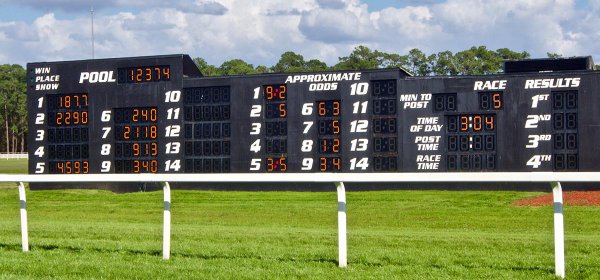
7. Reading the Tote Board and Live Odds
The tote board is the race’s conversation with you. Every flicker of the numbers shows how the market feels, and every change hints at risk and value. Learning to read that conversation gives you an edge that does not come from a tip sheet. It comes from understanding how crowds behave and how money moves.
Odds on the board are alive because the pools are alive. If a horse is 8/1 at ten minutes to post and 5/1 at two minutes, a surge arrived. That surge may come from a single large player, a group, or a wave of smaller bettors chasing the same idea. If a 2/1 favorite drifts to 4/1, skepticism has crept in, or another contender has captured attention. Watching these moves lets you decide whether an opportunity is opening or closing.
Overlays and underlays live on this board. An overlay is a horse whose price is longer than its fair probability suggests. If your work says a horse has about a 25 percent chance to win, a price of 6/1 is a gift because fair odds would be near 3/1. An underlay is the opposite. If a horse you see as a 15 percent chance is hammered down to 2/1, the reward is too thin for the risk. Recognizing these situations turns reading horse racing odds into a practical, repeatable skill.
The tote board also previews exotic outcomes. Many tracks display probable payouts for Exactas and the Daily Double before a race. These figures help you gauge whether your combinations are realistic or overly crowded. If a particular Exacta combination pays surprisingly low, the public sees it too, and you may want to adjust to avoid a thin return.
Late money deserves respect, yet not blind faith. A sudden drop from 7/2 to 2/1 can signal confidence from well-informed bettors, but it can also be herd behavior. Use the move as information, not a command. If the horse fits your handicapping, the odds change may confirm your opinion. If it does not, the price drop can be a reason to pass or to look for value on another runner.
The tote board is not a riddle. It is a running tally of opinion. The more fluent you become in its language, the better you become at timing, selection, and price sensitivity. That fluency is a core part of horse racing odds and payouts.
8. Favorites vs. Longshots
Every odds board stretches between favorites and longshots, and understanding both ends of that line will make you a more balanced bettor. Favorites are popular for good reasons. They win more often, they usually have the strongest past performances, and they often come from barns and riders who excel. On average, favorites win about one-third of the time, which makes them reliable in terms of probability but not always attractive in terms of price.
Short prices test discipline. A 3/5 favorite that wins pays $3.20 on a $2 Win ticket. String a few of those together and the bankroll grows slowly, yet a single upset can wipe out several earlier profits. That is why many players avoid leaning too heavily on chalk unless the situation is overwhelmingly in its favor. Choosing when to accept a short price is as important as spotting a long one.
Longshots live on the other end of the spectrum. A horse at 20/1 or 30/1 rarely wins, yet when it does, the payoff can change the day. A $2 Win bet at 20/1 returns $42. The key is finding longshots with logical paths to improvement. Positive trainer patterns, a return to a preferred distance, a switch to a surface the horse likes, or a projected pace scenario that falls apart in front of a deep closer can all transform a long price from hopeless to live.
Value bridges favorites and longshots. A favorite can be a value play if the price is fair, and a longshot can be a poor bet if the price is shorter than the horse deserves. Many successful bettors blend both ideas. They might single a strong favorite in one leg of a multi-race sequence and then spread with a couple of price horses in another. In vertical wagers, they might use a favorite on top and longshots underneath to capture a bigger share of the pool.
Perception often drives mispricing. Favorites can be overbet because casual players back names they recognize or ride trends. Longshots can be ignored because they lack flash. That imbalance creates opportunity for anyone willing to look deeper. The goal is not to become a “favorite player” or a “longshot player.” The goal is to become a value player who understands when the crowd’s confidence is justified and when it is a mirage.
9. Common Myths About Horse Racing Odds
Racing collects myths the way a barn collects hay, and those myths can quietly drain a bankroll. One of the most persistent is that favorites always win. The truth is simpler and less comforting. Favorites win about 33 percent of the time, which means two of every three races go to someone else. Short prices can be correct, yet the payoff rarely compensates for inevitable defeats unless you are selective.
Another myth says longshots are a waste of money. That is only true when the price does not match the chance. A $2 Win bet at 30/1 pays $62. You do not need many to hit in order to move your day from ordinary to memorable. The trick is to demand reasons beyond hope. A class drop into a realistic spot, a trainer who excels second off the layoff, or a switch to a track that rewards the horse’s running style can all justify a ticket on a price horse.
Morning line confusion lingers as well. Some players treat the morning line like a promise rather than a projection. It is a guide built by a handicapper to estimate how the market might behave. Final odds are set by the actual bets placed. The gap between projection and reality can be wide, and it often is. Treating the morning line as gospel leads to disappointment and poor decisions.
Late odds drops generate wild theories. A dramatic swing near post time can be caused by computer-assisted wagering, a large player making a stand, or a stampede of last-minute money chasing the same narrative. Sometimes the horse wins. Sometimes it does not. The move is a clue, not a guarantee. Let your handicapping lead and let price movement inform, not dictate.
Another misconception is that odds capture a horse’s true ability. Odds capture betting patterns. Ability and perception overlap, but they are not identical. A good horse can be overlooked and drift to a generous price. A modest horse can be hyped into an underlay. Keeping that distinction front and center protects you from paying premium prices for average chances.
Cutting through myths sharpens judgment. When you ground your play in facts, when you trust your preparation, and when you insist on fair prices, you turn noise into strategy. That is the real payoff of learning horse racing odds explained in honest terms.
10. Final Takeaways on Horse Racing Odds and Payouts
Racing rewards attention, patience, and a steady plan. Odds are not just a scoreboard. They are a living record of what thousands of bettors believe about a race. If you know how to read them, you can see where the crowd is right, where it is wrong, and where the price compensates you for taking a stand. That is the essence of horse racing odds and payouts.
Master the languages first. Fractional, decimal, and American odds tell the same story in different ways. When you can translate among them without hesitation, you stop fumbling with arithmetic and start focusing on whether a bet makes sense. Keep the difference between morning line and final odds in mind as well. The line is a forecast. The final number is your reality.
Never forget how the pari-mutuel system shapes everything. Pools gather the money, takeout reduces the pot, and the remainder is split among winners. That is why prices tighten when support floods in and why they drift when the crowd backs away. Watch the tote board as if it were a conversation with you. Look for overlays that fit your handicapping and avoid underlays that tempt without paying you properly for the risk.
Keep your math sharp. If you understand how to calculate horse racing payouts, you will know exactly what a $2 or $10 ticket means in real dollars at a given price. That clarity turns hunches into decisions. It helps you resist chasing short odds that do not pay enough and encourages you to take a fair shot when the number is right.
Above all, be a student of value. Favorites and longshots are tools, not labels. Use each when the price matches the probability. If the market gifts you 6/1 on a horse you rate closer to 3/1, step forward. If the market pounds a horse into 6/5 that you see as no better than a 3/1 shot, step aside. Discipline is the quiet edge that separates recreational betting from sustained success.
Horse racing will always deliver surprises. That is part of the magic. The bettors who thrive accept the uncertainty while insisting on good prices. They study, they watch the board, they calculate, and they choose their spots. With horse racing odds explained clearly, with a firm grip on reading horse racing odds, and with a practiced approach to how to calculate horse racing payouts, you put yourself in the best position to turn insight into tickets and tickets into returns.